


 October 6, 2026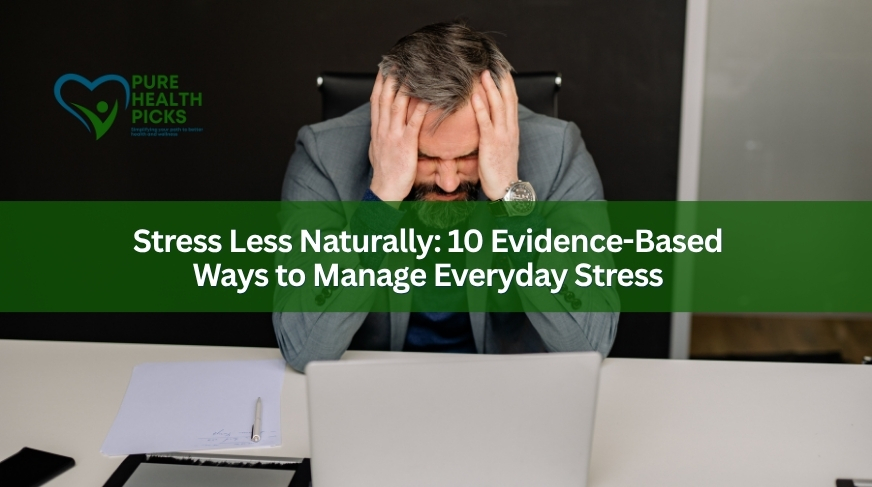
Stress is part of being human.
A busy workday.
A difficult conversation.
Financial pressure.
Family responsibilities.
Health concerns.
Too many notifications.
Too little sleep.
Sometimes stress helps you respond to a challenge. But when stress becomes persistent and starts affecting sleep, mood, concentration, relationships, or daily functioning, it deserves attention.
The good news is that managing everyday stress does not always require complicated routines.
There are simple, evidence-informed habits that can help you build resilience and create more opportunities for your body and mind to recover.
These include movement, sleep, breathing, mindfulness, outdoor time, social connection, journaling, healthy nutrition, and healthier boundaries around information and technology.
The important word is management.
The goal isn’t to eliminate every stressful moment.
The goal is to develop healthier ways of responding to stress.
Table of Contents
- What Does “Stress Less Naturally” Actually Mean?
- When Is Stress Normal?
- When Can Stress Become a Problem?
- 10 Natural Ways to Manage Stress
- Exercise and Stress
- Mindfulness and Stress
- Breathing Exercises
- Sleep and Stress
- Nature and Outdoor Time
- Social Connection
- Nutrition and Stress
- Screen Time and Information Overload
- What Recent Research Says
- Latest Discoveries in 2026
- A Simple Daily Stress-Management Routine
- Common Mistakes
- Frequently Asked Questions
- When to Seek Professional Help
- Final Takeaway
What Does “Stress Less Naturally” Actually Mean?
“Stress less naturally” should not mean ignoring professional healthcare or replacing treatment with home remedies.
Instead, it means using healthy lifestyle and behavioral strategies to help manage everyday stress.
Examples include:
- Walking
- Exercise
- Stretching
- Deep breathing
- Mindfulness
- Meditation
- Spending time outdoors
- Getting adequate sleep
- Connecting with people you trust
- Journaling
- Taking breaks
- Limiting excessive news and social-media exposure
- Eating a balanced diet
The CDC recommends several of these approaches as healthy ways to cope with stress.
These strategies are not magic cures.
They are tools.
And different tools work differently for different people.
When Is Stress Normal?
Stress is the body’s physical and emotional response to challenging or unfamiliar situations.
It can occur because of:
- Work
- School
- Relationships
- Financial concerns
- Health problems
- Major life changes
- Family responsibilities
- Uncertainty
Occasional stress is normal.
In some situations, a short-term stress response can help you focus, adapt, and respond to a challenge.
The problem is when stress becomes persistent and difficult to manage.
The CDC notes that long-term stress can contribute to worsening health problems and may be associated with problems involving sleep, concentration, appetite, energy, physical symptoms, and existing health conditions.
10 Natural Ways to Manage Everyday Stress
1. Move Your Body
If stress has you sitting still and overthinking, movement can provide a useful interruption.
You don’t necessarily need a gym membership.
Try:
- Walking
- Cycling
- Dancing
- Swimming
- Stretching
- Yoga
- Strength training
- Playing a sport
- Gardening
Physical activity can provide immediate benefits for mental wellbeing.
The CDC reports that moderate-to-vigorous physical activity can reduce short-term feelings of anxiety and improve sleep, while regular activity is associated with lower risks of depression and other health problems.
A useful starting point is simple:
Walk for 10 minutes.
You can build from there.
The CDC also emphasizes that some physical activity is better than none and that people can gradually build toward recommended activity levels.
Stress strategy:
When you feel overwhelmed, don’t automatically reach for another screen.
Try taking a short walk first.
2. Try Mindfulness
Mindfulness means paying attention to the present moment without immediately judging every thought or feeling.
It can be practiced while:
- Sitting
- Walking
- Eating
- Breathing
- Stretching
- Drinking tea
- Spending time outdoors
You don’t have to meditate for an hour.
Start with two minutes.
Sit comfortably.
When your mind wanders, gently return your attention.
That is the practice.
What Does the Research Say?
A 2026 systematic review and meta-analysis examined 17 randomized controlled trials involving 1,641 non-clinical adults and found evidence supporting mindfulness-based interventions for reducing perceived stress.
Another 2026 meta-analysis examining the association between mindfulness and perceived stress also contributes to the growing research base in this area.
The important qualification:
Mindfulness is a stress-management tool—not a universal cure for anxiety, depression, or other mental-health conditions.
3. Use Slow, Intentional Breathing
When you’re stressed, your breathing may become faster or shallower.
A deliberate breathing exercise can create a short pause.
Try this:
Inhale gently.
Exhale slowly.
Repeat for several breaths.
Don’t force the breath.
Don’t hold your breath if that makes you uncomfortable.
The purpose is simply to slow down and pay attention.
The CDC includes deep breathing, meditation, and relaxation techniques among healthy ways to cope with stress.
A simple 60-second reset
Stop.
Relax your shoulders.
Take a comfortable breath in.
Exhale slowly.
Repeat.
Then ask:
“What is the next thing I actually need to do?”
This can turn an overwhelming moment into one manageable action.
4. Protect Your Sleep
Stress and sleep have a complicated relationship.
Stress can make it harder to sleep.
Poor sleep can make the next day feel more difficult.
That is why sleep belongs in any serious stress-management plan.
The CDC recommends consistent bedtimes and wake times and notes that adults generally need at least seven hours of sleep per night.
Try creating a predictable evening routine.
Before bed:
- Reduce stimulating activities
- Put away unnecessary notifications
- Keep your bedroom comfortable
- Avoid excessive caffeine late in the day
- Give yourself time to unwind
- Keep your sleep schedule reasonably consistent
The CDC also recommends turning off electronic devices at least 30 minutes before bedtime as part of healthy sleep habits.
Remember:
Don’t sacrifice sleep to create more time for stress-management activities.
Sleep itself is part of the strategy.
5. Spend Time Outdoors
Going outside can provide a simple change of environment.
You might:
- Walk through a park
- Sit in a garden
- Eat lunch outside
- Walk around your neighborhood
- Spend time in natural surroundings
- Take a short outdoor break
The CDC specifically recommends spending time outdoors as one healthy way to unwind and manage stress.
You don’t need to turn every outdoor experience into a performance.
Sometimes:
Just go outside.
6. Connect With Someone You Trust
Stress often becomes heavier when you carry it alone.
Talk to:
- A friend
- Family member
- Partner
- Colleague
- Mentor
- Counselor
- Community member
You don’t always need someone to solve the problem.
Sometimes being heard is useful.
The CDC recommends connecting with people you trust and notes the importance of social connection for wellbeing.
Try this:
Instead of saying:
“I’m fine.”
Try:
“I’ve had a stressful week. Can I talk to you for a few minutes?”
A simple conversation can create space.
7. Take Breaks From News and Social Media
Information overload can become another source of stress.
You open your phone for five minutes.
Then:
News.
Social media.
Notifications.
Arguments.
Emails.
More news.
More notifications.
The brain rarely gets a quiet moment.
The CDC specifically recommends taking breaks from news and social media when they become upsetting or overwhelming.
Try creating:
Notification-free meals.
Screen-free walks.
Phone-free conversations.
A short social-media window instead of constant checking.
This connects directly to the Pure Health Picks topic:
Screen Time Balance — Unplug. Recharge. Thrive.
8. Write It Down
Journaling can help you put thoughts into words.
You don’t need an expensive journal.
Use a notebook.
This can transform a vague feeling of overwhelm into a more concrete problem-solving process.
The CDC includes journaling among healthy stress-management strategies.
Try the 3-column method
| Stressor | Can I control it? | Next action |
|---|---|---|
| Work deadline | Partly | Break task into steps |
| Someone else’s opinion | No | Stop replaying conversation |
| Poor sleep | Partly | Create earlier wind-down |
The goal isn’t to write pages.
The goal is clarity.
9. Eat for Overall Wellness
There is no magical “anti-stress food.”
Be skeptical of claims that one tea, powder, herb, or supplement can eliminate stress.
Instead, focus on an overall nutritious eating pattern.
The CDC recommends emphasizing foods such as:
- Fruits
- Vegetables
- Whole grains
- Lean protein
- Lower-fat dairy where appropriate
and limiting excessive added sugars, salt, and unhealthy fats.
This connects naturally to the Pure Health Picks content ecosystem:
Power of Whole Foods
Eat More Fiber
Healthy Breakfast
Sugar Awareness
Hydration Changes Everything
Nutrition is not a substitute for mental-health treatment.
But taking care of your physical health can support overall wellbeing.
10. Practice Gratitude Without Forcing Positivity
Gratitude can be useful.
But there’s a difference between:
“I am grateful for something good in my life.”
and:
“I shouldn’t feel stressed because other people have it worse.”
The second approach can invalidate genuine emotions.
The CDC recommends gratitude as one possible stress-management strategy and suggests writing down specific things you appreciate.
Try writing:
One person I appreciate.
One thing that went well.
One small thing I’m looking forward to.
You can acknowledge stress and gratitude at the same time.
Study Review: What Does Current Evidence Suggest?
The research landscape around stress management is becoming more sophisticated.
Instead of looking for one miracle intervention, researchers are increasingly examining combinations of behavioral strategies.
Mindfulness
The 2026 systematic review discussed above included 17 randomized controlled trials and 1,641 participants. Its findings support mindfulness-based interventions as a potentially useful approach for reducing perceived stress among non-clinical adults.
What this means: Mindfulness has a meaningful evidence base, but effects vary between people and interventions.
Physical Activity
Current CDC evidence summaries emphasize both immediate and long-term mental-health benefits of physical activity. A single moderate-to-vigorous session can reduce feelings of anxiety and improve sleep, while regular activity provides broader health benefits.
What this means: You don’t necessarily need a perfect workout program to begin.
Movement itself can be useful.
Sleep
The evidence and public-health guidance consistently position sleep as a major component of physical and emotional wellbeing. The CDC recommends consistent sleep schedules and adequate sleep duration.
What this means: If you’re chronically sleep-deprived, adding more wellness activities may not be the best first move.
Start by protecting sleep.
Latest Stress-Management Discoveries in 2026
1. Mindfulness Research Is Becoming More Rigorous
The 2026 systematic review is notable because it focused specifically on randomized controlled trials rather than simply collecting observational associations.
That distinction matters.
It strengthens the evidence that mindfulness-based interventions can be useful for perceived stress, while still leaving questions about which techniques work best, for whom, and how long benefits persist.
2. Researchers Are Looking Beyond “Mental” Stress
Stress management is increasingly being viewed as a whole-person issue.
Sleep.
Movement.
Nutrition.
Social connection.
Digital exposure.
Relaxation.
These factors interact.
The CDC’s current stress guidance reflects this integrated approach by combining mental strategies with physical-health behaviors.
3. Physical Activity Is Being Treated as a Mental-Wellness Tool
The latest CDC physical-activity guidance emphasizes that activity can produce immediate improvements in anxiety and sleep, in addition to longer-term health benefits.
That makes walking an especially practical intervention.
And it can be combined with social connection or outdoor time.
Natural Stress Relief: What About Supplements and Herbs?
This is where wellness content often becomes misleading.
Products marketed for stress may contain ingredients such as:
- Ashwagandha
- Magnesium
- Herbal blends
- CBD
- Adaptogens
- Other botanical ingredients
But “natural” does not automatically mean:
Safe.
Effective.
Appropriate for everyone.
Supplements can interact with medications and may be unsuitable for certain health conditions.
Therefore, Pure Health Picks should avoid promising that a supplement “cures stress.”
If you’re considering a supplement for stress, discuss it with an appropriately qualified healthcare professional, particularly if you take medication or have an underlying health condition.
A Simple Daily Stress-Less Routine
You don’t need to practice every technique.
Try this basic routine.
Morning
5 minutes outdoors
Get some daylight and move gently.
Midday
10-minute movement break
Walk or stretch.
Afternoon
Notification break
Step away from news and social media.
Evening
5 minutes of breathing or mindfulness
Give your mind a transition between the day’s demands and your evening.
Night
Protect your sleep
Aim for a consistent sleep schedule.
This creates a simple framework:
Move → Breathe → Connect → Unplug → Sleep
The 5-Minute Stress Reset
Feeling overwhelmed right now?
Try:
Minute 1
Stop what you’re doing.
Minute 2
Take several comfortable, slow breaths.
Minute 3
Relax your shoulders and unclench your jaw.
Minute 4
Identify the one thing you can control.
Minute 5
Take one small action.
This isn’t designed to solve your entire life.
It creates a pause.
Sometimes that’s the first step.
Common Mistakes When Trying to Reduce Stress Naturally
Mistake 1: Trying Everything at Once
You don’t need ten new habits tomorrow.
Start with one.
Mistake 2: Using Wellness to Avoid Real Problems
Meditation cannot solve every workplace, financial, relationship, or health problem.
Mistake 3: Treating Supplements as a Shortcut
Natural does not automatically mean effective or safe.
Mistake 4: Ignoring Sleep
You cannot sustainably recover while chronically sleep-deprived.
Mistake 5: Forcing Positive Thinking
Acknowledging difficult emotions is healthier than pretending they don’t exist.
Mistake 6: Waiting Until You’re Completely Overwhelmed
Stress management works better as a daily practice than as an emergency response.
Frequently Asked Questions
What is the best natural way to reduce stress?
There is no single best method for everyone. A combination of regular movement, adequate sleep, mindfulness or breathing, outdoor time, social connection, and healthy daily routines can provide a strong foundation for stress management.
Does exercise reduce stress?
Yes. Physical activity can provide immediate mental-health benefits, including reduced feelings of anxiety, while regular activity is associated with broader mental and physical health benefits.
Can mindfulness really reduce stress?
Research supports mindfulness-based interventions as a useful approach for reducing perceived stress in many adults. A 2026 systematic review and meta-analysis included 17 randomized controlled trials with 1,641 participants.
Can deep breathing help with stress?
Deep breathing and relaxation techniques are recommended by the CDC as healthy ways to cope with stress.
Does walking help with stress?
Walking is a form of physical activity and can be an accessible way to incorporate movement into your day. Physical activity can reduce feelings of anxiety and support sleep and mental wellbeing.
Can nature reduce stress?
Spending time outdoors can be a useful relaxation strategy, and the CDC specifically includes outdoor time among healthy stress-management practices.
Can social media increase stress?
Constant exposure to upsetting or negative information can become stressful. The CDC recommends taking breaks from news and social media when they contribute to distress.
What foods reduce stress?
There is no single food proven to eliminate stress. Instead, focus on an overall balanced eating pattern containing vegetables, fruits, whole grains, protein foods, and other nutrient-dense choices.
Does sleep affect stress?
Yes. Sleep and stress can influence one another. Healthy sleep habits, including a consistent schedule and adequate sleep duration, are important components of overall wellbeing.
Is natural stress relief a replacement for therapy?
No. Lifestyle strategies can complement professional care, but persistent or severe mental-health symptoms may require professional assessment and treatment.
When Should You Seek Professional Help?
Natural stress-management strategies are appropriate for everyday stress.
But don’t try to handle everything alone.
Consider speaking with a healthcare professional or mental-health professional if stress:
- Feels overwhelming
- Persists for a prolonged period
- Interferes with work or school
- Disrupts relationships
- Seriously affects sleep
- Causes major changes in appetite or functioning
- Leads to persistent anxiety or low mood
- Makes everyday responsibilities difficult
The CDC recommends seeking professional support when stress becomes difficult to manage or interferes with daily life.
If someone is in immediate emotional crisis or at risk of self-harm, seek urgent professional or emergency support rather than relying on self-help strategies.
Final Thoughts
You don’t have to eliminate stress from your life.
That’s probably impossible.
Instead, learn how to respond to it differently.
Walk.
Breathe.
Sleep.
Stretch.
Go outside.
Talk to someone.
Write things down.
Put the phone away.
Eat nourishing food.
Give your mind a break.
And remember that asking for professional help is not a failure of “natural wellness.”
It is part of taking care of yourself.
The strongest approach to stress management is not a miracle herb or a perfect morning routine.
It is a repeatable system of healthy behaviors and appropriate support.
Start small.
Choose one strategy today.
Then repeat it tomorrow.
Stress less. Breathe more. Move more. Connect more. Live well.
Pure Health Picks — practical wellness information for healthier everyday choices.
Health disclaimer: This article is for general educational purposes and is not a substitute for individualized medical or mental-health advice. If you have persistent or severe symptoms, take medications, or have a health condition, consult an appropriately qualified healthcare professional before making significant changes to your treatment, exercise, diet, or supplement routine.